×

Learning

Learning at Home

Children are continuously learning everyday and you are their ‘first and foremost educator’. The best thing you can do is be a fabulous role model as whatever you do your little one will pick up on it.

There’s loads of new and interesting things you can do, don’t spend a fortune, the best things you can do cost very little. Walking through our woods and down to the lake, or going by bus to one of Newcastle’s free museums. Being at home is just as much fun too, helping garden, make tea or sort the washing piles.

Although technology is great please keep it to a minimum around your child and if you must use it only allow them to play on age appropriate games. At preschool we don’t focus on technology a lot as we prefer real life experiences as children learn so much more from them. Keep your own phone and tablet use to a minimum too when you’re around your child, research has shown children’s language abilities may become affected if your communication with your child is limited.

Natural resources are wonderful, full of learning potential and things to chat about as well as free. Collecting them can be a fun day out while you search for new and interesting things. Give your child a little bag and fill it with leaves, sticks, pebbles, shells, conkers, feathers, pine cones, acorns etc. You can make natural art with them all, patterns, line them up in size order, paint, make wands, draw in the mud, make fairy houses etc.
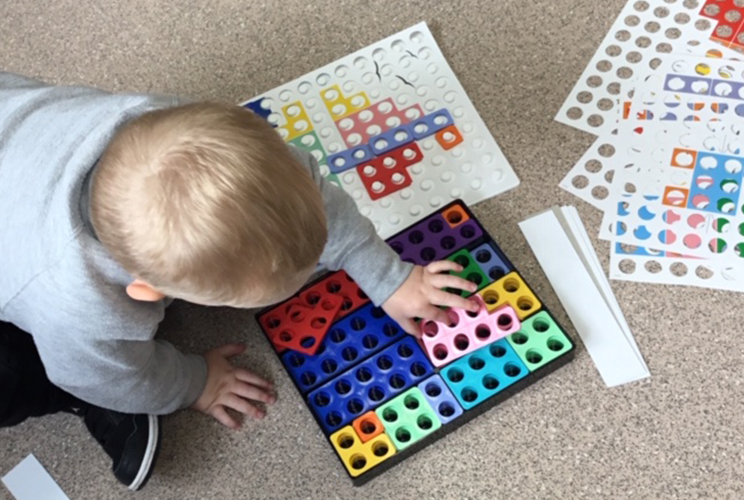
Some ideas to support your child to learn at home:

  • Make a camp, build a fort, use throws, duvet covers, sofa cushions etc. It’s a great spot for watching tv in.
  • Play table top games, but remember they shouldn’t always be the winner or they’ll find it tough when they get to preschool or school and they don’t always win.
  • Sing together and encourage your child to learn as many nursery rhymes as possible. Try making them fun and interactive, act it out or make some puppets.
  • Learn some songs about anything and everything, such as washing your hands.
  • Bake or help make tea. Children begin to understand about washing hands to remove germs, follow a recipe, learn how to use tools safely and most of all if they’re a fussy eater making their own food encourages them to eat.
  • Research has also shown the best time for your child to take in new learning from a story is at bedtime, so make the most of your child’s bedtime routine to have a story and a chat. Stay away from watching TV in bed at bedtime as this stimulates the brain to stay awake or have bad dreams.
  • There really are many ways to help your child learn at home, every minute is an opportunity for them to absorb new learning, even if you haven’t planned it.
  • Try a colour treasure hunt around the house. Mrs Wood can give you an idea here.
  • Or perhaps a sound game such as this one to encourage listening skills.

Literacy at Home

Here are some fun ideas to encourage good reading habits, explore letters and sounds, building up muscles.
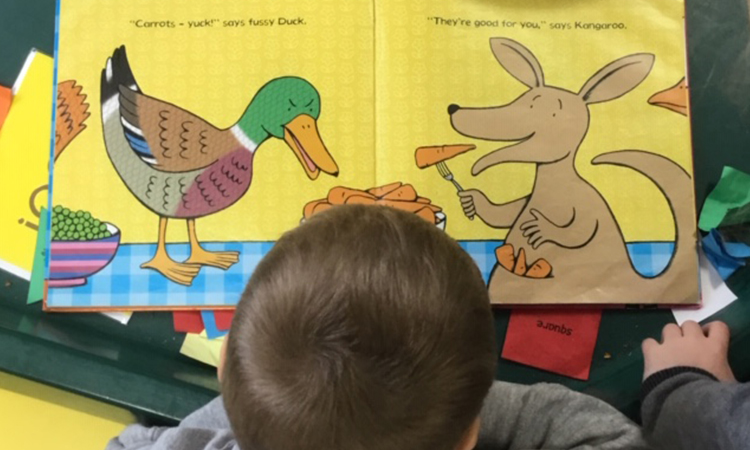
  • Snuggle up and read with your child every day.
  • Have a special place to keep your books.
  • Take your child to the library, let them choose exciting books with a library card.
  • Let your child act out the story. They might be moving but they are still listening!
  • Talk about interesting words and what is happening on the picture in the book. Mrs. Wood talks about ‘stripey’ things in the story ‘Simon’s Sock’
  • Make up a new ending (what would happen if … happened instead).
  • Look at a new book, can your child guess what the story is about from looking at the pictures.
  • Show your child how much you love reading and use expression and humour when reading to them.
  • Use your finger to trace each word as you read it.
  • Give your child their own short shopping list with words and pictures. Make your own picture books.
  • Play I Spy (use the letter sounds, remember to learn to correct phonics sound).
  • Play rhyming I spy.
  • Do a rhyming scavenger hunt (what can you find that rhymes with box…)
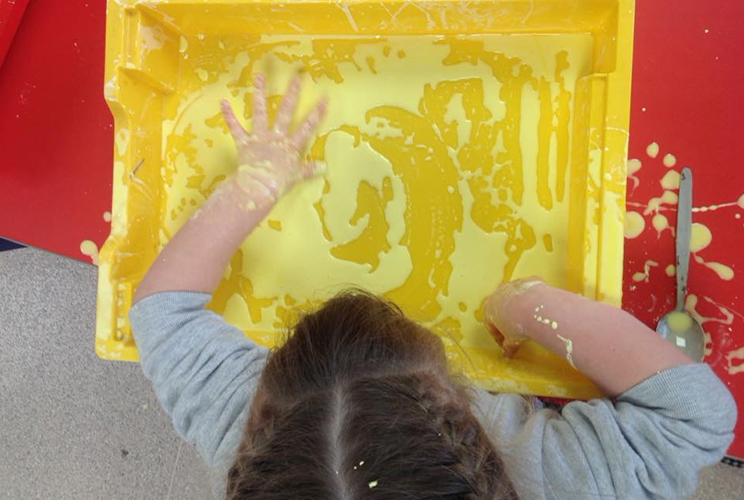
  • Make letter shapes out of play dough.
  • Write their name in the sand at the beach or mud in the garden.
  • Sing lots of songs and nursery rhymes.
  • Make mistakes when singing (and get caught)…old MacDonald had a shop…incey wincey chicken… head shoulders beans on toast… etc.
  • Look for environmental print, shop signs, lorries, tins in your cupboard, games boxes etc.
  • Make your own picture books.
  • Lots of drawing, painting, glue and stick.
  • Make cards and allow them to write their own name in cards.
  • Pick things up using tweezers and tongs.
  • Baking, follow a recipe together.
  • Threading beads and buttons
  • Doing up their own buttons, shoes and zips.
  • Crawl and climb.

Splat the Cat by Rob Scotton (Harper Collins Publishers 2008) read by Mrs Wood.

Is your little one a little nervous about starting preschool or school? Listen to the story of Splat’s first day at school read by pre-school’s Mrs Wood.

Maths at Home

Here are some ideas that can help your child develop their mathematical skills both in the home and out and about with the family.

Everything children encounter contributes toward their mathematical development. The home learning environment is a significant factor in predicting young children’s later outcomes. Even daily chores can be be learning experiences which can be made ‘play-full’ by encouraging a sense of fun and enjoyment while the child learns and develops

No matter how confident you are, you can support your children’s maths skills at home. Help them think of fun activities, they don’t have to be complicated or written down. It is the simple practical things where children are active that works best. Physical activity develops children’s working memory which links directly to improvements in areas such as numeracy and spatial reasoning (how we understand the way things move and are located in relation to ourselves and others).
Number

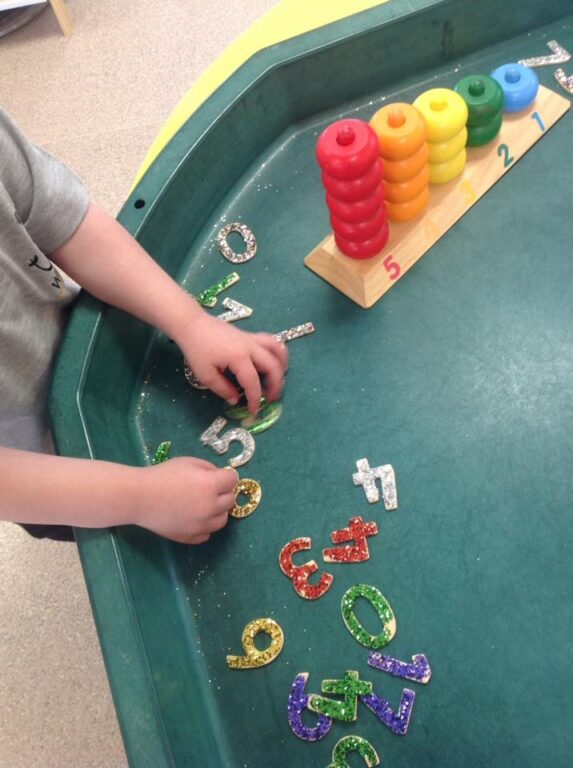
  • Counting steps/stairs as you go up or down.
  • Finger or action rhymes that include numbers – 5 little sausages, 5 current buns, 5 little ducks etc.
  • Look for house / door numbers while out and about.
  • Recognising numbers on the bus or car registration plates.
  • Identify numbers on TV remote or cooker.
  • Helping with the shopping – we need three oranges and two lemons. How many altogether?
  • Talking about the child’s age and those of the rest of the family.
  • Use ordinal numbers (first, second, third etc.) in going through steps of a recipe, having a race down the garden, or getting dressed in the morning.
  • Handling money at the shops. Role playing ‘shops’ at home using coins and counting out the right number
  • Drawing child’s attention to the clock – e.g. we’ll have tea when the big hand is on the 6
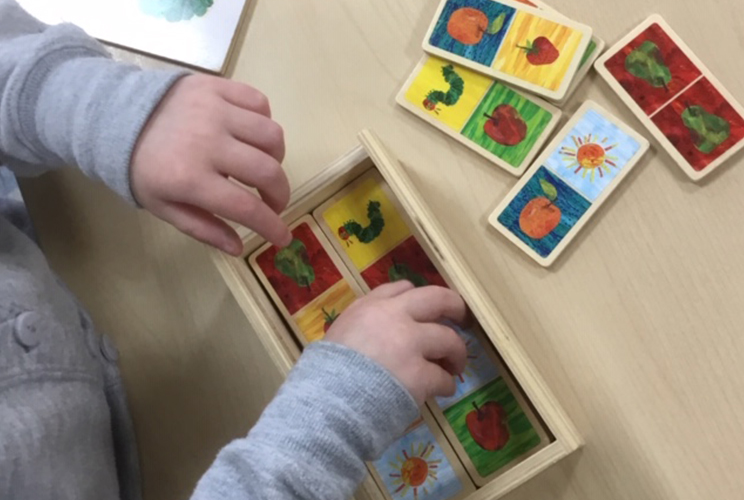
  • Play board games with dice or dominoes so they understand the group of dots represent a number

Sets and Sorting

  • Sorting the washing
  • Tidying away toys – getting the toys in the right boxes
  • Pairing up socks and shoes
  • Talking about similarities and differences between objects or people
  • Sorting everyday objects in the kitchen.
  • emptying the dishwasher and putting matching things away (cutlery, plates and bowls etc.).

Pattern

  • Following different sequences e.g. laying the table, getting dressed, in the same way each time
  • Singing songs or telling stories with a clear pattern, sequence of repetition, e.g. Old MacDonald, Three Blind Mice, Three Billy Goats Gruff
  • Looking at the patterns on curtains, wallpaper, wrapping paper. Children can print their own wrapping paper to wrap a friend’s birthday present
  • Looking at patterns on buildings e.g. bricks in wall, windows
  • Building with blocks and different construction toys – using one piece after another.
  • Laying the table – putting things in a repetitive pattern.
  • Helping peg out the washing – 2 socks, 1 t shirt etc.
  • Talking about events throughout the day in order of sequence

Shape, Space and measure

  • Describing different containers and packets in the kitchen and at the supermarket, talk about their size, their shape, their height, width and depth.
  • Finding shapes in the child’s own environment e.g. road signs, post-boxes, windows and doors, books). Look for similarities and differences, talk about how many sides to a shape, corners, points, rounded etc.
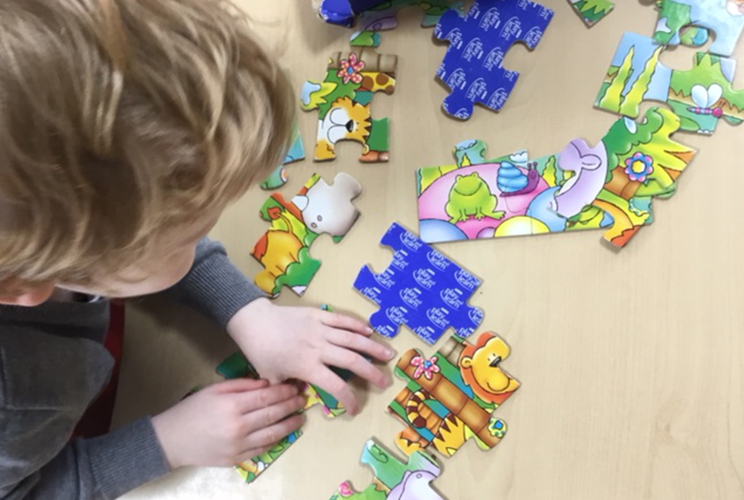
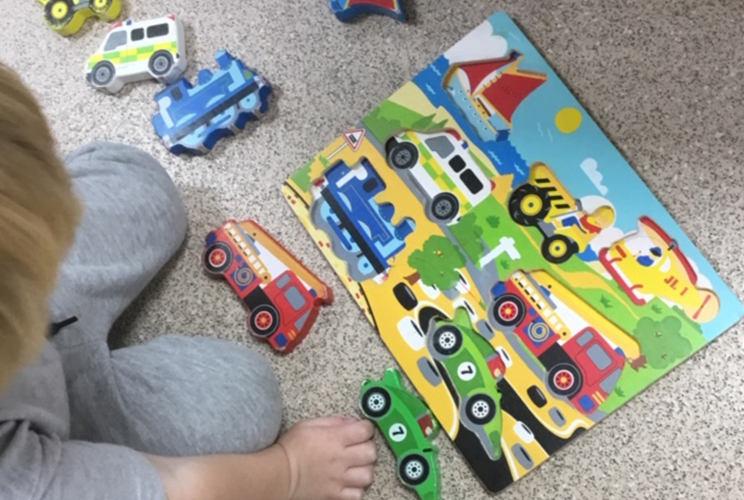
  • Doing jigsaw puzzles (looking at the shapes of the pieces and the ‘holes’ where they could go, and keeping the overall shape of the puzzle develops spatial awareness). Encourage your child to look at the picture for clues of where pieces should go, look at the shape of the piece, is it the right shape for the hole?
  • Playing with car mats, train sets, or outside on tricycles. talk about being infront, behind, beside, over taking, going fast or slow etc.
  • Estimating how much is needed, for example, how much bread to make 4 sandwiches, how much icing to ice the cake. Talk about a little bit more or less.
  • Playing in the sand pit using different containers, talk about their weight, full or empty, pouring slowly and fast etc.
  • Bath time or washing up time – pouring from one container to another, filling different containers, using containers with holes. Talk about full, empty, half full or half empty.
  • Tidying things away into different boxes and containers – will we fit them all in?
  • Comparing different lengths (dog’s lead, socks, shoelaces), weights (shopping bags, toys), areas (footprints of child and adult), sizes (teddies, chairs for child and adult) and capacity (child’s beaker and adults’ glass, bottles of squash).
  • Measure your child’s height at regular intervals so they can see their growth. Talk about the tallest and smallest.
  • Use a tape measure to measure things (careful of the spring back on an adults tape measure). Talk about length, centimetres, meters, shortest, longest etc.

Outdoor Maths

Learning doesn’t just happen indoors, there are loads of maths opportunities outside, even on a walk in the woods. Wherever possible take advantage of the abundance of natural mathematical experiences that children can discover outdoors.  There are lots of free resources there to collect too: pine cones, leaves, sticks, stones shells etc.

  • Counting cars (how many red, blue) etc. on the way to nursery or the shops.
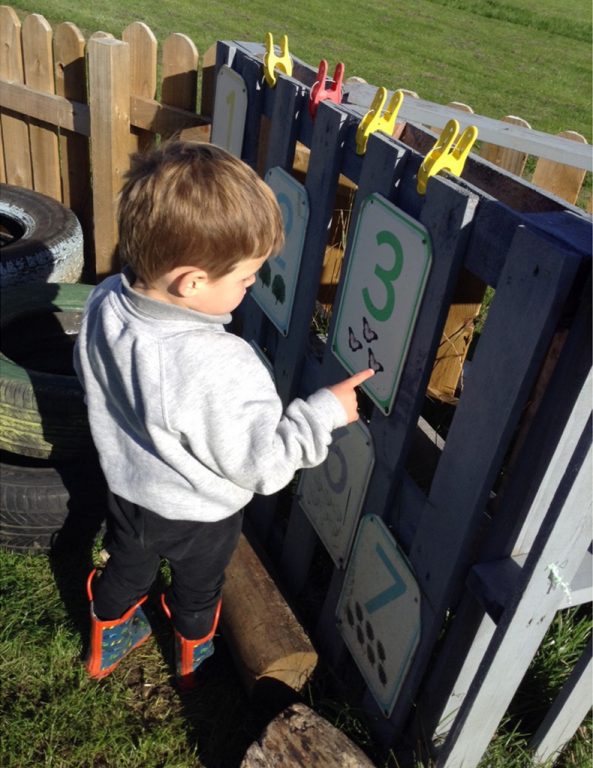
  • Looking at numbers around us – on house doors, registration plates, shop windows.
  • collect sticks, pine cones, conkers and line them up in size order.
  • collect stones and look at their shapes and sizes.
  • collect sticks, which is the longest, shortest, can you make a shape with them, how long can you make a line if you lie them along the ground.
  • pick up leaves and find matching ones, count the points, size order, do they resemble any shapes.
  • look around you for shapes, windows, roof, drain covers, street signs etc.
  • Make a sundial on a sunny day by simply sticking a stick into the ground and watch the shadow move. You could chalk a line on at each point.
  • Catch rainwater and predict / estimate how much you can catch.
  • Go on a bug hunt and count how many of each species you find, you could make a tally chart.
  • Have a maths obstacle course, have spots to hop twice, jump 3 times, you could even chalk the number onto the areas for numeral recognition, ask them to go on the highest blocks or lowest.

The list is endless.

Whatever you do make it fun, learning through play allows children  to take risks, make mistakes, try new things, think creatively and make connections. Adults meaningfully engaging in their play demonstrates your respect and value for it, while providing opportunities to extend, model, practice, consolidate, introduce new ideas, concepts and vocabulary.
Make your own play dough

Print out an easy to follow recipe and encourage your child to follow it making the dough themselves. This develops your child’s understanding that print carries meaning, if you point to the pictures and words they will soon recognise what each one means.

The recipe we use in preschool:

2 cups flour

1 cup salt

2 cups water 

1 tablespoon oil

1 tablespoon cream of tartar

food colouring optional (add to water)

scent such as essence optional (add to water)

glitter optional (add anytime)

*Put all the ingredients into a bowl and mix together using wooden spoon.

*Microwave for 5 minutes on full power.

*leave to cool for a while then knead removing any hard or crispy edges.

The local authority has developed a leaflet regarding being ready for school and learning at home, here is the link for it.

What people say about us

"Since joining the Nursery my daughter has developed in so many ways. She is more confident and balanced and looks forward to going into nursery everyday." Parent of Child
“Thank you so much for the past year and a half. From day one of me being in bits about potty training you have always offered so much help and support.” Parent of Child
"Because of you I will always have the memory of the time my child showed me he could put on his own coat and shoes himself. The pride in his face I will never forget." Parent of Child
I just wanted you to all know how amazing you have all been this past year, my child has came on so much since September. Thank you for all your help dealing with the teams he is under, I would have been lost since his diagnosis but you have helped us through it. Parent of a child
Thank you all for a fabulous first term, my child talks about preschool and all of his teachers with a huge smile on his face which is all I can ask for. Parent of a child
View all reviews